Sunday, 10 October 2010

2007 It Had to Happen Sometime-Did I Mention The Rain?

The day was planned to travel slowly east through Switzerland towards the Austrian Alp region, managing to complete three passes on the way. These were the Col de Corbier, Col de la Croix and finally, Col du Pillion.

Stopping at the summit of the Col du Pillion there is a cable car that can take punters up to the world’s highest Alpine Coaster ride. We were tempted to try this however the price 6 Swiss Francs (CHF) for the coaster but another 33 CHF for the cable car. A trip to the nearby could be taken for a mere 54 CHF. All these went under the banner of Glacier 3000. With the cloud coming down and obscuring the mountain tops this helped our decision to move on.

Travelling along the A8 towards Interlaken there were a few spots of rain in the air so we turned towards the town, booking in at the Hotel Derby. The Guzzi was placed in the garage for the evening.

Then the rain came down. It was time to shelter in our room for a couple of hours. With the need to eat becoming stronger we headed towards the centre of town and

decided on Bebbie’s tacky burger bar. Inside there was a group of Japanese tourists getting the complete Swiss “Experience”. The décor was a mixture of wood panelling, pictures, various flags from around the world, wooden figures holding a glass of beer or an Alpen horn and a ladder suspended from the ceiling festooned with various bells, which the owner shook on occasions to try an liven up the place. A few of the Japanese tourists then became the floorshow as a selection of Alpen horns were brought into the centre of the restaurant, not very tuneful but taken in good spirit. Some of the members of staff then showed us how they should be played. At least this took our minds off the rain.

Back in the warmth of the hotel Guzzisue had a play on the hotel’s internet to check out her blog and the weather forecast. Rain was expected for the next four days across Austria and Germany, heavy rain for Tuesday in Southern Switzerland. We are seriously thinking of changing our plans, but for now we will sleep on this and see what happens in the morning.

Any idea of going further east disappeared, like the sun, from the start. We were woken up by a dawn chorus of the heavy spotted thunderstorm. Having checked out the weather forecast on the morning television, the weathermen had indeed got it correct last night. It did not take much of a decision to stay in Interlaken for another night.

Eventually the rain abated and we went for a walk down to the lakeside. On the way this little mountain goat came up to their enclosure fence

and told us to look at the mountain tops.

There was some fresh snow on the high ground. We had been so engrossed in looking at various items along the way that the snow had not been noticed by any of us. It did not appear to be too much to worry about, so it was soon forgotten about.

As its name may suggest, Interlaken is situated between two lakes, Brienz to the east and Thun to the west. The river Aare connects the lakes. Our walk took us to the local sailing club, situated close to Lake Brienz. Several yachts were moored up in the harbour, sheltering from the incoming weather. The clubhouse was all locked up so there was no chance for a warming drink.

And then the rain came down again. Fortune was on our side as there was a bus shelter nearby with one due in ten minutes.

Back in the town centre we found the local museum, situated behind a fountain in a quiet area.

Eventually there was a small break in the deluge and Guzzisue managed to take a few photos. As we have come to expect, many of the building are brightly painted with the occasional mural thrown in.

Hiding in some local foliage was this woodcarving titled Potscheboum.

With more rain coming down it was back to the hotel and hide for a while. This persisted into the evening when we trudged back into town for a meal. Not wanting the same as last night Hooters gave us lads some beautiful scenery to look at. Guzzisue even thought that the fayre was not too bad either.

No matter where you are rain literally puts the dampers on everything. It would be too judgemental to give Interlaken the thumbs down because of this. In the vicinity

there is the Schilthorn, advertised as the top of Europe and used in the James Bond movie On Her Majesty’s Secret Service. This is a must for us in the future, however because of the cost it may well be way into the future.

Roll on tomorrow and we will be rolling on whatever happens.

Thursday, 23 September 2010

2007 It Had to Happen Sometime-So Far, So Good

We awoke at the crack of mid-morning after the excursions of yesterday, the sun was beaming, sky was blue and the view wonderful.

The remainder of the morning was spent relaxing before heading towards Morzine for lunch. Stopping off at a lake for a Sunday stroll and a few photo sessions for Guzzisue plus a very rare shot of Guzzisue and Ian together!

Mozine is the nearest large town boasting of…not much really. Although it boasts plenty of winter sports and mountain biking for summer, we had gone there during the ‘in between’ season.

Noticing the Luge d’été, a toboggan run designed for plastic sledges with wheels, we left Elaine as the helmet attendant and proceeded to have a go. We got to the top of the run by the same method as the sledges were returned,

giving us a good view of the town and the toboggan run.

Returning to the apartment Ian let Andrew and Elaine take the Guzzi out for a spin to show her different styles of motorcycle pillion comfort. Andrew certainly enjoyed the experience judging by his Cheshire cat grin.

The evening was spent at the local pizza parlour/bar before retiring early. Andrew and Elaine were travelling on to Paris in the morning and we were going to ride a few mountain passes, crossing into Switzerland before further east.

Next day saw us up bright(?) and early. Elaine did some last minute cleaning

Before joining all of us putting the last touches loading the bikes.

With farewells said we departed St Jean d’Alps and went our separate ways.

So far, so good….

Friday, 3 September 2010

2007 It Had to Happen Sometime-The Beginning

Always in life there are tasks that are put off for as long as possible. There are different reasons for this, for example, it might be a job that is dirty, or tedious, or no benefit can be appreciated on its completion. The task in question here is our 2007 trip over the water.

We were only a few weeks from setting off and none of us had any idea on where to go. Work matters for Ian and Guzzisue had taken priority over everything. Then at a bike rally down in Essex a chance meeting with a friend, Andrew, accompanied by his fiancée, Elaine, mentioned that they were going to be in a ski apartment during the weekend that we were crossing the Channel. Would we care to join them for the first weekend? Well we didn’t need to be asked again!

With the address details forwarded to us in good time we depart Nottingham on a Friday night for Dover. Arriving at the hotel shortly after 22:00 we had our customary bedroom picnic whilst watching television.

Saturday dawns and Ian and myself take the luggage down to the Guzzi. Keeping our steed company was a smart BMW RT that belonged to the night porter. It turned out that the porter is a member of Dover 69 Motorcycle Club and we have mutual friends from near Gloucester. Small world indeed!

Having proceeded to the ferry terminal without problems, we boarded with three Harleys. Guzzisue took pity on the P&O men that were strapping down the machines as the owners were most concerned about their paintwork. During the crossing we discovered that two of the Harleys were bound for the European Bike Week, a large convention that can have around 50,000 people, as we discovered last year riding back through Austria after visiting the Czech Republic.

With the Guzzi’s wheels once again turning on foreign roads we took our usual route away from Calais, first heading through Reims and then onto Troyes. Having passed Troyes we passed a convoy of ‘movie makers’’ vehicles including dressing rooms, costume wagon and the inevitable portaloo. Many months later we discovered this was part of the ‘on location’ bandwagon for the new Merlin series being produced by the BBC. Riding onwards, we passed Langres, although this time there were no patchwork quilts to be seen. Besancon came and went, followed by the Swiss border. The obligatory stop for the purchase of road tax was made interesting as there was a car being stripped by the border guards.

We were permitted to enter Switzerland without any delay and headed for Lausanne and the motorway around Lake Geneva. Travelling east we stopped at the same service station as our previous visit. Fuel in the Guzzi and a much needed chocolate fix for the three of us, having travelled over 400 miles, disaster strikes. Complete electrical failure. When confronted with a problem the usual British answer is a cup of tea, however, Guzzisue went and got more cups of hot chocolate! Having removed the seat, Ian checked all the fuses and relays before finding the problem – a loose connection on the battery. If only everything was this simple.

It was starting to get dark as we entered Evian, complete with its grand hotels and casino, built on the profits of bottled water (?) It certainly looks like a place to come and have a look around in the future.

Ian is now faced with the daunting task of driving the final 15-20 miles on a road climbing into the mountains with a headlight that could be related to Lucas, Prince of Darkness. On a couple of occasions he nearly went into the mountainside as it was almost the same colour as the road! Ian’s plan was to ride slowly until a car overtook him and then follow the tail lights for as long as possible.

Eventually we reached St Jean d’Alps and remembered Andrew’s instructions, the third block after the ski lift. The sign for the ski lift was seen without a problem, however on leaving the village behind going into total darkness and going into the mountain we thought that we had passed the landmark, so back down we go. On returning to the village a quick phone call to Andre for more directions gets us going back the same way but taking a left turn onto a one way street. This time we end up at the top of the village! Third time lucky, as the saying states, back on the original route we see Andrew standing by the roadside. If only we had travelled an extra half mile the first time…

It was now 22:00 and we had travelled over 500 miles since the morning, food prepared by Elaine and wine were waiting on our arrival and conversation like the wine flowed until the early hours.

Tuesday, 10 August 2010

Uttoxeter Motorcycle Show

Although the 4th Uttoxeter Classic Bike Show and Autojumble, organised by the VJMC opened its gates to the public at 09:30, Ian and myself did not arrive in the parking area until 10:00. The reasoning behind this is simple. Let the early queue to get in disperse and to have a look around the bike park to see some fine machinery.
The Triumph, or should that be BSA? Trail Blazer seen below was one of many British motorcycles to be seen in the parking area.

Back in 1975, Ian was just a zit faced sixteen year old lad. On returning home from a family holiday his father stopped off at a motorway service station. In the car park on that rainy day there just happened to be a motorcycle, on its sidestand, away from all other vehicles,

and so thank you Kawasaki for producing the Z900 and setting one young oik* on the winding road of life with a target to aim for. He had no money in the bank and one year to go before he reached the age to ride a motorcycle. The rest as they say is history.

Honda were well represented in the parking area. Two machines that caught my eye were this very tidy CL450

and this CBX1000 that manages to out ‘Sei’ the Benelli 750 Sei. The Sei was the first production six cylinder road motorcycle, based on Honda’s CB500, it was stunning with its 6-6 exhaust system. The production model of the CBX had a 6-2 system, however this particular example was something else!

Rapidly fading into history are the old prejudices and the “Jap crap” remarks, as could be verified by the fact that many British motorcycles were on display inside the show.
This was obvious from first setting paw and foot into the show ground. Immediately on the left, in the Paddock Pavillion building was the Vincent HRD club. They sandwiched the Parade Ring, where during the day several owners were interviewed and their machines run, with the BSA Gold Star Club. It was an oversight on my behalf that I forgot to get any photographs of any of these machines.

Swiftly moving on, Ian and myself entered the Staffordshire Stand building. Just to the right of the doorway was a sad looking machine with its machine details card stating ‘This bike was saved from the skip, people ask why!!’

I recall that previously Affer and myself have had a little discussion on this motorcycle(?). The owner was not to be seen. I wonder if he has heard about the Ariel 3 Museum in Bristol?
Occupying the area next to the Ariel was a small collection of GPO Motorcycles owned by John Lawrence.

These were accompanied by the helmet, gloves and telegram satchel from the correct era.

A brief history of the telegram messenger service can be found here.

Ian and myself spent a while chatting with John about his collection and also discovered he was once a messenger himself.

Ian and myself then continued to look around the other exhibits in the room, taking photos of one of the motorcycles in particular, more of which at the end of this post.

There were several trade stands immediately outside the Staffordshire Stand building that we perused before entering the Exhibition Hall. Once inside we glanced at several of the different owners’ club stands before noticing this pair.

This RE 5 we have met before at the Castle Donnington Show in 2008,

however I was more drawn to the 750 Honda below.

Owned by Fred Brown, the motorcycle was bought new in 1971 when he was working in Saudi Arabia for transport. When his contract was completed, in 1972, he decided to ride the Honda home, a distance of 5000 miles completed in eight and a half days.

Next door in the Exhibition Marquee there was an interesting combination, the MZ Club next to the Kettle Club.

The early 1960’s Suzuki racers were copies of the MZs after their rider, Ernst Degner, defected during the Swedish Grand Prix in 1961. I wonder what Walter Kaaden would have made of this pairing as Suzuki went from strength to strength while on December 12th 2008 the MZ factory in Zschopau closed, bringing a halt to motorcycle production that had lasted for 88 years in the same town. The old 'East German' factory became a night club, called MZWerk.

Crossing over the race course we entered the aptly named Centre Course Marquee. Inside was an assortment of VJMC sections’ stands manned by their members.

This particular machine had Ian reminiscing over the television series C.H.I.Ps that was produced between 1977-83.

Hiding in the far corner of the marquee was this 1948 Corgi. Developed from the Welbike, which was built for parachute drops and around the airfields during WWII, was produced until 1954, during which time it had helped to get Great Britain back on her feet.

No show would be complete without an auto jumble, today was no exception. Ian is still looking for the elusive badges for his Suzuki. There was no fortune for him again, one day…. Slowly as NOS (new old stock) dries up for certain machines undergoing restoration, prices rise. This in turn pushes up the price of restored motorcycles, for example, the RV 125 below.

At £3750 it may be some time before it is sold.

Returning to the perimeter we had a look in the Railway Stand Marquee. Recently several clubs have opted to show a cutaway of an engine. I’m pleased to say that the CBX Riders (UK) Club have joined the ranks. This rotating display took a few attempts to get a reasonable picture.

Although the show was open until 17:00 to the public many were departing by 15:00. By the time that we returned to the Suzuki the bike park was two thirds empty. Will we go again? Yes. The show clashes with a motorcycle rally that we often attend so it will be a couple of years before we attend again.

One final thing that I must do is this:

Two posts ago I set a little task with this picture


The motorcycle is a

and the model is

Congratulations to Affer at getting it correct at the second attempt. All that is required now is to the identity of the owner.

That is revealed HERE.


*An unsophisticated, uncultured and objectionable person.

Sunday, 8 August 2010

Chocks Away Part 3, Happy Landings

I have been searching for Cockersdale singing Keith Marsden’s ‘Left Left Right Steady Man’ since I posted the first part of ‘Chocks Away’ to no avail. I have managed to locate the lyrics and they are printed below.

Left Left Right Steady Man

1.
Rear gunner on a lancaster in spring of 'forty four,
Son, don't ever volunteer-o,
I'd seen my share of fighting and I'd had my fill of war,
Son, don't ever volunteer-o,
Over Stettin, over Norway, over Munich and Berlin,
I'd lost count of all the scraps and scrapes, near misses I'd been in,
But I only needed three more trips to get my nineteen in,
Son of mine, don't ever volunteer-o.
I got a left, left, right, steady man, oops!, go round again,
Go round again, lord what a pain,
Blind as a bat he was and where was his brain,
Left, left, right, steady man, oops!, go round again.
2.
I signed on with the new lot to make up a trip or two,
Son, don't ever volunteer-o,
I should have seen the warning signs, their flying suits were new,
Son, don't ever volunteer-o,
No-hopers, never-would-be's and all wet behind the ears,
The other fellows told me that by bed time there'd be tears,
But I never dreamt how they'd fulfil the worst of all my fears,
Son of mine, don't ever volunteer-o,
I got a left, left, right, steady men, oops!, go round again,
Go round again, lord what a pain,
On his wedding night, it was such a sight, you could hear his wife complain,
About left, left, right, steady man, oops!, go round again.
3.
It should have been an easy trip, some dams off Falkland way,
Son, don't ever volunteer-o,
The kind of trip you go to miss, to try another day,
Son, don't ever volunteer-o,
The flak was light, the fighters few, a piece of bread and jam,
Drop short to get that extra trip, for god's sake miss the dam,
Then flick your wings to spoil the film and back to blighty scram,
Son of mine, don't ever volunteer-o,
I got a left, left, right, steady man, oops!, go round again,
Knock ein again, the german gunners refrain,
And the night fighter pilot, he was laughing like a drain,
At left, left, right, steady man, oops!, go round again.
Left, left, right, steady man (2)
4.
He shot us through the bomb bay and he shot us through the wings,
Son, don't ever volunteer-o,
He shot away the engines and he shot away the fins,
Son, don't ever volunteer-o,
We staggered past the beaches and we put down in the drink,
All seven in one dinghy as the light began to sink,
And in the rush the skipper never even stopped to think,
Son of mine, don't ever volunteer-o,
He set the left, left, right, steady man, oops!, go round again,
To steering us back, sure he must have been cracked,
With a chump like him on compass would we see England again,
Left, left, right, steady man, oops!, lost on the maine.
5.
We paddled round in circles two whole days and two whole nights,
Son, don't ever volunteer-o,
Till gleaming through the mist and rain at last we saw some lights,
Son, don't ever volunteer-o,
"Ahoy! are we near England" shouted left-left silly bugger,
"Are you the air-sea rescue or perhaps some fishing lugger",
"Ach, nein, ve are an E boat in ze harbour of Zeebrugge"
Son of mine, don't ever volunteer-o,
I got a left, left, right, steady man oops! go round again,
Got us out of the drink, and straight into clink,
The possibility of future fatherhood for him we all made quite plain,
To left, left, right, steady man, oops!, go round again.
6.
Should have been on leave in Blackpool spending all my Nuffield pay,
Son, don't ever volunteer-o,
With holes burnt in my pockets and a new girl every day,
Son, don't ever volunteer-o,
But I'm sitting in this stalag, going mad on acorn tea,
And wishing I could be there in old A.C.R.C.
For the bleeding left, left, steady man is bunking next to me,
Son of mine, don't ever volunteer-o,
I got a left, left, right, steady man oops! go round again,
The war finished last week, but he's tunnelling again,
He's down there still digging, we're all catching the train,
Without left, left, right, steady man, oops!, go round again.


As this trip comes into land Ian told me about a comedy duo, The Oblivion Boys that Guzzisue and himself had seen in the past. Apart from appearing in several sketches on television programmes in the 1980’s they did a series of advertisements for a brand of larger. The product is not to our liking but their commercials are well remembered, especially this one with the upkeep mines.


Something to look forward to in my next post (which is nearly ready), the answers to my photo quiz. All will be revealed this week.

Thursday, 22 July 2010

Chocks Away Part 2

For the concluding part of this daytrip, I am going to concentrate on two aircraft and a collection of exhibits that should have been in closer proximity to each other.This is the sight that greeted us in the hanger after we had looked at a model display of an operations room plotting the Luftwaffer’s approach over the English Channel.


In the left foreground we can just make out “the UK’s smallest piloted aircraft”, as advertised in the 1960’s. Still uncompleted, it is the design of Mr M Ward from near Newark. However it is the aircraft on the right that grabbed our attention.


This is a replica of Lee Richards Annular Biplane. Its number is BAPC No.20, or in its entirety British Aviation Preservation Council Number 20.

The aircraft is based on an original design, featuring an annular (circular) wing. It was built for the 1965 film Those Magnificent Men In Their Flying Machines, in which it was ‘flown’ by the character Harry Popperwell, played by Tony Hancock.

Newark Air Museum acquired the aircraft in 1967, shortly before it was due to be destroyed. Originally stored in Newark, it moved to the museum in the early 1970’s where it remained in storage awaiting restoration. In February 2000 it was then placed on loan with the Shoreham Airport Historical association, who then proceeded to restore it to its former glory. After a brief period with it being displayed at their West Sussex site the aircraft returned to Newark in August 2006.

The Gnat was adopted by the RAF’s aerobatic team in September 1964, making their first public appearance at the Farnborough Air Show. Originally named the ‘Yellowjacks’ as their aircraft were painted yellow, the name was changed in 1965 when a new paint scheme was adapted, with a name change to The Red Arrows.


The Gnat remained the Red Arrows chosen aircraft until the end of 1979 when it was replaced by the BAe Hawk.

The Gnat on display is painted in red and white, similar to the Red Arrows colour scheme. This design was used by training command at RAF Valley.

Designed by W.E.W. Petter, the Gnat was part of a private venture for the Folland Aircraft Company. XR534 was built at Hamble, Hampshire and entered RAF service in 1963.

XR534 had an extensive flying career before being reconditioned at Dunsford, Surrey in 1969, followed by major servicing at RAF Kemble, Gloucestershire in early 1974. Overhaul complete and the Gnat travelled to No. 4 Flight Training School at RAF Valley, Anglesey in March of the same year. It served with the School until it was replaced with Hawks in 1977.

To the left of the Gnat is a Gnat Procedures Trainer. This was used to train cadets in basic cockpit drills and escape techniques.

Propped against the hanger wall, in the proximity of the Gnat is this well made stained glass picture of a Lancaster bomber.


I can only assume that this is a memorial to Squadron 617, the Dambusters squadron. There was no information about this piece of work, thus leaving me none the wiser.

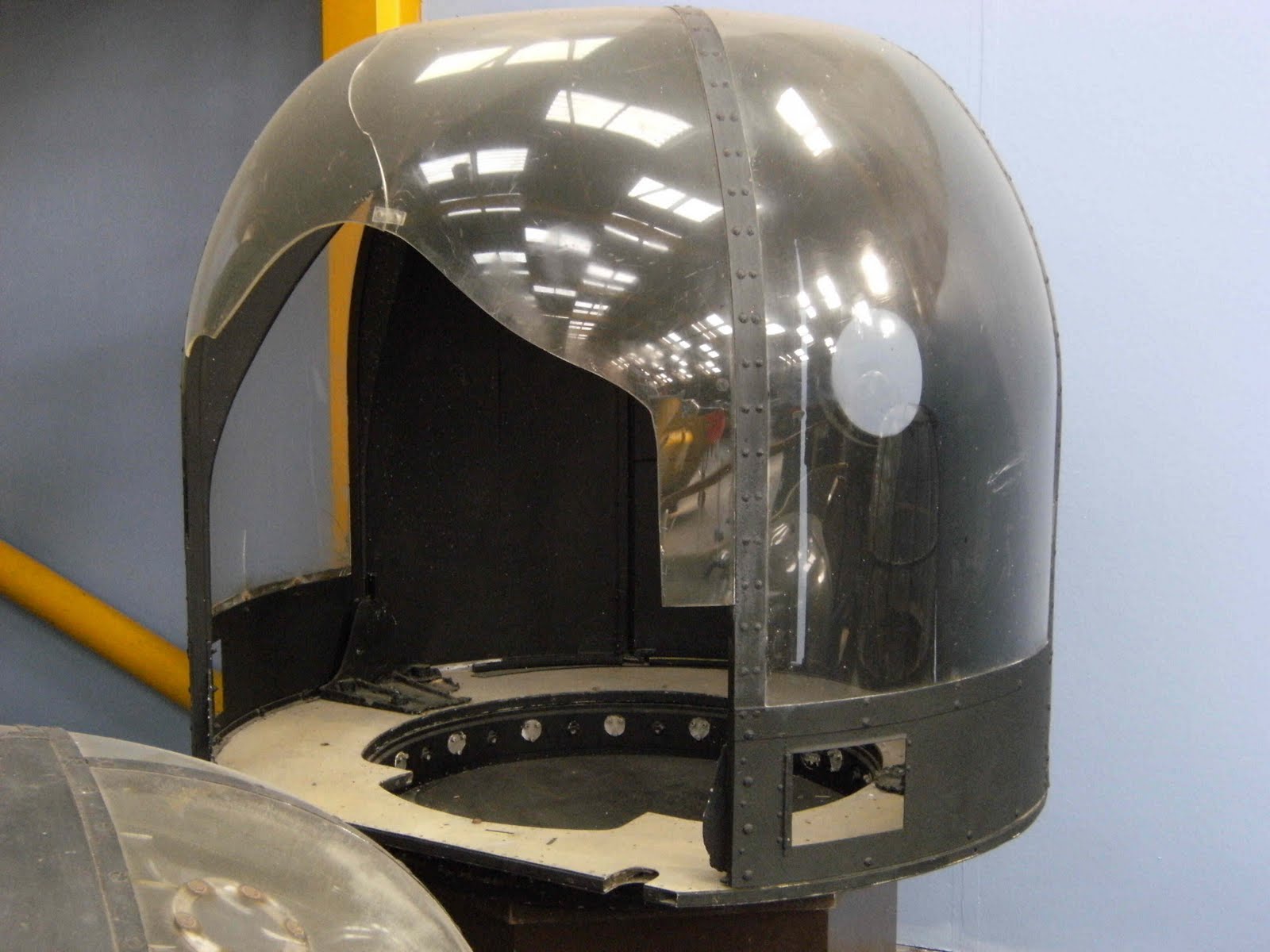
At the far end of the hanger are two Lancaster bomber turrets. The rear turret below was built by Rose Brothers Ltd of Gainsborough, Lincolnshire and housed twin 0.5 inch Browning guns with a fifing capacity of 335 rounds per gun.


The Mid Upper Turret would have been equipped with two 0.303 inch Browning machine guns.


Hiding in the corner near the turrets is this Upkeep mine. This test bomb was recovered in June 1997, having been dropped at Reculver in 1943.


The Upkeep mine was one of three bombs designed by Barnes Wallis that were being tested for attacks against Germany. The Royal Navy had shown interest in a bouncing bomb with the idea of using this method for attacking the Tirptiz, codenamed Highball. There was also a smaller version, Baseball. This was to be a bomb that could fire at warships from motor torpedo boats. The whole family of bombs were given the codename “Golfmine”.

With time going against us, we found refuge inside the café for a well deserved cheese and ham toastie before heading back into the shop. Along the back wall was any boys dream with a plethora of model aircraft.


The item that caught my eye was this


now all I have to do is grow so that I’m the size of a six year old. Now that could take some time!

Sunday, 4 July 2010

What Is It?

Yesterday Ian and myself travelled along a road so straight and tedious, even the Romans would query as to where they were. The road in question was the A50. Fortunatly we only had to traverse half way along, to Uttoxeter Racecourse.

The VJMC were in attendance with their 4th motorcycle show at this particular venue, report to follow at a later date.

Many different clubs attended and also some weird and wonderful machines from the past. The question I'm putting to you, my reader, what does this engine power and who do you think might own it?

Meanwhile I must finish part two of Chocks Away

Sunday, 20 June 2010

Chocks Away Part 1

Hands (or paws) up all those who are guilty of ignoring what is on their doorstep. My paw is half raised, as are Ian and Guzzisue’s hands.

Over the years when Ian’s nephew and niece were up from Southampton we would take them to a local place of interest or an event. Recently they are content with going around the shops or the cinema.

A few years ago we had a Canal Museum in Nottingham, which we visited on several occasions. However, this was closed down due to lack of visitors. Upon hearing of the loss, a listener to our local radio station rang in to complain about this. They were asked one question by the presenter

“Have you ever been to the museum?”

Not surprisingly the answer was an emphatic “No”, and still they argued the toss about the closure.

The museum is now a canalside bar, as if we needed any more!

I have previously posted about Nottingham’s Big Night Out, an idea of BBC Radio Nottingham’s Breakfast Show presenter Andy Whittaker. Following on from this, we now have the Big Day Out. This is an event in which many of the museums within Nottinghamshire open their doors for free. This was the incentive we needed to visit one of the museums that we have passed by countless time throughout time.

Newark Aircraft Museum is partly hidden from the roadside but well signposted. It is situated between the A46 and A17, with access down a short track.

Having peered through the fence for a few minutes we ventured into the shop/museum entrance, a printout showing the Radio Nottingham Big Day Out list of places to visit was all we needed to gain entrance. We were handed a ‘Suggested walking tour’ sheet, which was promptly ignored as we headed for the largest exhibit on show, the Avro Vulcan B.2 XM594.


XM594 was first flown in 1963 and soon was deployed to the Blue Steel armed independent British Nuclear Deterrents Force with 27 squadron at RAF Scampton. It was later transferred to Waddington before once again returning to Scampton.

Refurbished in 1972, XM594 spent the next few years being transferred to different squadrons until February 7th 1983 when it was flown from RAF Waddington to Winthorpe.

Leaving XM594 behind we wandered around the perimeter stopping briefly at G-BFTZ. This aircraft is a Socata MS.880B Rallye Club. Designed by Morane Saulnier, the Rallye originated when the French Government held a competition for a light aircraft in the 1950’s. The aircraft is still in production in Poland as the “Koliber”.


Originally registered in France as G-BFTZ, it flew with the registration F-BPAX. The record books show that this aircraft was first registered in the United Kingdom in 1978 and passed through several owners before being removed from the serviceable aircraft list in 1994. It arrived at the museum in 1996.

Trying to hide in the corner of the museum’s grounds was this Handley Page, Hastings T.5 TG517.


This aircraft was designed to be a multi-purpose transport aeroplane and in later years was used for training.

TG517 was the19th to be produced and came into service in 1948, during this period the aircraft took part in “Operation Plainfare”, The Berlin Airlift.

In 1950, TG517 was fitted with special weather reconnaissance equipment and served in Northern Ireland until 1958, after which it was one of five aircraft to be fitted out with radar bomb-sight equipment before being allocated to the RAF Bombing School at RAF Lindholme, where it remained until 1968.

TG517’s last operations were from RAF Scampton, where the aircraft saw active service in the Icelandic “Cod War” flying four fishery protection sorties. She was finally flown into the museum in 1977.

For a small charge of 50 pence, several of the aircraft had their cockpits open for view. These also had an accompanied guide giving details about the aircraft. There had been a steady queue to look inside the Vulcan, so we took the opportunity to have an inspection of the Hastings.


Having climbed the steps into the fuselage and paid our entry, the guide gave us a brief history of the aircraft before letting us inspect the rest of the aircraft.

The seats shown in the above photo can be removed and be replaced with stretchers, if the need should arise. There are also hooks in the floor so that large cargo can be transported, making it a very versatile aircraft. In the background we can see part of the radar bomb-sight equipment from a Vulcan. This was used for the training of Vulcan, Phantom and Buccaneer crews. With no one looking I had the opportunity to have a go myself. Left, left, right, steady, whoops. Go round again. (With all apologies to Cockersdale)


Realising that I would never make a Biggles Ted I clambered down and went to have a look at the cockpit.


I assume the buckets are to catch either condensation from behind the console or water that may gain entry either through weakened nose panels or the cockpit . Please correct me if I’m wrong on this assumption.

Continuing around the perimeter we stopped briefly at this Mikoyan-Gurevich MIG-23M “Flogger”.


Designed between 1964-66, the MIG-23 was a successor to the MIG-21. Besides having a more powerful engine it also had a variable sweep wing with three settings, 16, 45 and 72 degrees. With the wings swept right back, the aircraft has a greater speed, while fully spread it was able to carry a heavier weapons load.

The prototype first flew in public during the aviation Day Flypast at Domodedove Airport, Moscow on 9th July 1967and entered service in 1970, becoming fully operational in 1973.

In contrast to the MIG-23, this English Electric Lightning T.5 XS417 has had a chequered career.


XS417 was the first production T.5 and flew 47 development flights before joining 226 OCU at RAF Coltishall, Norfolk in 1965. At the end of this year it transferred to 23 squadron RAF Leuchars, Fife, where in 1965 it suffered a Cat.3 ground explosion in July 1966.

Between 1974 and 1987, XS417 passed through several squadrons and had periods when it was placed into storage. On 6th April 1987, XS417 flew in the LTF’s formation flypast at RAF Binbrook. One month later the aircraft was once again placed into store, this time being stripped for spares. The museum bought the aircraft in 1988 and cut the wings off before transporting it back to Newark Air Museum in September 1988.

Around the museums grounds are an engine display hall, an exhibition hall and two display hangers that contain more aircraft. I will discuss this on my next post.

Saturday, 3 April 2010

Whoops

This is an event that happened to Ian many years ago and I hope will act as a reminder to anyone getting their motorcycle out of hibernation right now.

Upon returning from our first Cornish rally, Ian parked the Guzzi on the drive for half an hour to unpack and get a drink before returning it to his shed at his father's. The drive is so steep that he is thinking of building a small funicular railway to aid assent.

Refreshed he swung a leg over the Guzzi, started the engine, went a few inches....and stalled. Thinking he needed more revs, the Guzzi was restarted, more revs added, forward motion, followed by an almighty thud. This was the result.

It is a good idea to remove the disc lock before trying to set off!

When the weekend was over the follow conversation ensued:

Ian: Have you got a disc for a Calli in stock?

Storeman: Trying to set off with a disc lock on have we sir?

Ian: Yeah. How did you guess?

Storeman: We used to keep only one in stock, we now have to keep five.

Cost of this lapse in concentration? A mere £130 + VAT and postage.

For some reason, Ian now uses a long chain that threads through the rear wheel and the lock sits on the pillion seat.

All this has got me thinking as to what I can do with the above disc. Can it be used like an old horseshoe on the front door at Ted Towers? Your ideas are very much welcomed.