I have been searching for Cockersdale singing Keith Marsden’s ‘Left Left Right Steady Man’ since I posted the first part of ‘Chocks Away’ to no avail. I have managed to locate the lyrics and they are printed below.
Left Left Right Steady Man
1.
Rear gunner on a lancaster in spring of 'forty four,
Son, don't ever volunteer-o,
I'd seen my share of fighting and I'd had my fill of war,
Son, don't ever volunteer-o,
Over Stettin, over Norway, over Munich and Berlin,
I'd lost count of all the scraps and scrapes, near misses I'd been in,
But I only needed three more trips to get my nineteen in,
Son of mine, don't ever volunteer-o.
I got a left, left, right, steady man, oops!, go round again,
Go round again, lord what a pain,
Blind as a bat he was and where was his brain,
Left, left, right, steady man, oops!, go round again.
2.
I signed on with the new lot to make up a trip or two,
Son, don't ever volunteer-o,
I should have seen the warning signs, their flying suits were new,
Son, don't ever volunteer-o,
No-hopers, never-would-be's and all wet behind the ears,
The other fellows told me that by bed time there'd be tears,
But I never dreamt how they'd fulfil the worst of all my fears,
Son of mine, don't ever volunteer-o,
I got a left, left, right, steady men, oops!, go round again,
Go round again, lord what a pain,
On his wedding night, it was such a sight, you could hear his wife complain,
About left, left, right, steady man, oops!, go round again.
3.
It should have been an easy trip, some dams off Falkland way,
Son, don't ever volunteer-o,
The kind of trip you go to miss, to try another day,
Son, don't ever volunteer-o,
The flak was light, the fighters few, a piece of bread and jam,
Drop short to get that extra trip, for god's sake miss the dam,
Then flick your wings to spoil the film and back to blighty scram,
Son of mine, don't ever volunteer-o,
I got a left, left, right, steady man, oops!, go round again,
Knock ein again, the german gunners refrain,
And the night fighter pilot, he was laughing like a drain,
At left, left, right, steady man, oops!, go round again.
Left, left, right, steady man (2)
4.
He shot us through the bomb bay and he shot us through the wings,
Son, don't ever volunteer-o,
He shot away the engines and he shot away the fins,
Son, don't ever volunteer-o,
We staggered past the beaches and we put down in the drink,
All seven in one dinghy as the light began to sink,
And in the rush the skipper never even stopped to think,
Son of mine, don't ever volunteer-o,
He set the left, left, right, steady man, oops!, go round again,
To steering us back, sure he must have been cracked,
With a chump like him on compass would we see England again,
Left, left, right, steady man, oops!, lost on the maine.
5.
We paddled round in circles two whole days and two whole nights,
Son, don't ever volunteer-o,
Till gleaming through the mist and rain at last we saw some lights,
Son, don't ever volunteer-o,
"Ahoy! are we near England" shouted left-left silly bugger,
"Are you the air-sea rescue or perhaps some fishing lugger",
"Ach, nein, ve are an E boat in ze harbour of Zeebrugge"
Son of mine, don't ever volunteer-o,
I got a left, left, right, steady man oops! go round again,
Got us out of the drink, and straight into clink,
The possibility of future fatherhood for him we all made quite plain,
To left, left, right, steady man, oops!, go round again.
6.
Should have been on leave in Blackpool spending all my Nuffield pay,
Son, don't ever volunteer-o,
With holes burnt in my pockets and a new girl every day,
Son, don't ever volunteer-o,
But I'm sitting in this stalag, going mad on acorn tea,
And wishing I could be there in old A.C.R.C.
For the bleeding left, left, steady man is bunking next to me,
Son of mine, don't ever volunteer-o,
I got a left, left, right, steady man oops! go round again,
The war finished last week, but he's tunnelling again,
He's down there still digging, we're all catching the train,
Without left, left, right, steady man, oops!, go round again.
As this trip comes into land Ian told me about a comedy duo, The Oblivion Boys that Guzzisue and himself had seen in the past. Apart from appearing in several sketches on television programmes in the 1980’s they did a series of advertisements for a brand of larger. The product is not to our liking but their commercials are well remembered, especially this one with the upkeep mines.
Something to look forward to in my next post (which is nearly ready), the answers to my photo quiz. All will be revealed this week.
Showing posts with label Newark Aircraft Museum. Show all posts
Showing posts with label Newark Aircraft Museum. Show all posts
Sunday, 8 August 2010

Thursday, 22 July 2010
Chocks Away Part 2
For the concluding part of this daytrip, I am going to concentrate on two aircraft and a collection of exhibits that should have been in closer proximity to each other.This is the sight that greeted us in the hanger after we had looked at a model display of an operations room plotting the Luftwaffer’s approach over the English Channel. 


In the left foreground we can just make out “the UK’s smallest piloted aircraft”, as advertised in the 1960’s. Still uncompleted, it is the design of Mr M Ward from near Newark. However it is the aircraft on the right that grabbed our attention.

This is a replica of Lee Richards Annular Biplane. Its number is BAPC No.20, or in its entirety British Aviation Preservation Council Number 20.
The aircraft is based on an original design, featuring an annular (circular) wing. It was built for the 1965 film Those Magnificent Men In Their Flying Machines, in which it was ‘flown’ by the character Harry Popperwell, played by Tony Hancock.
Newark Air Museum acquired the aircraft in 1967, shortly before it was due to be destroyed. Originally stored in Newark, it moved to the museum in the early 1970’s where it remained in storage awaiting restoration. In February 2000 it was then placed on loan with the Shoreham Airport Historical association, who then proceeded to restore it to its former glory. After a brief period with it being displayed at their West Sussex site the aircraft returned to Newark in August 2006.
The Gnat was adopted by the RAF’s aerobatic team in September 1964, making their first public appearance at the Farnborough Air Show. Originally named the ‘Yellowjacks’ as their aircraft were painted yellow, the name was changed in 1965 when a new paint scheme was adapted, with a name change to The Red Arrows.

The Gnat remained the Red Arrows chosen aircraft until the end of 1979 when it was replaced by the BAe Hawk.
The Gnat on display is painted in red and white, similar to the Red Arrows colour scheme. This design was used by training command at RAF Valley.
Designed by W.E.W. Petter, the Gnat was part of a private venture for the Folland Aircraft Company. XR534 was built at Hamble, Hampshire and entered RAF service in 1963.
XR534 had an extensive flying career before being reconditioned at Dunsford, Surrey in 1969, followed by major servicing at RAF Kemble, Gloucestershire in early 1974. Overhaul complete and the Gnat travelled to No. 4 Flight Training School at RAF Valley, Anglesey in March of the same year. It served with the School until it was replaced with Hawks in 1977.
To the left of the Gnat is a Gnat Procedures Trainer. This was used to train cadets in basic cockpit drills and escape techniques.
Propped against the hanger wall, in the proximity of the Gnat is this well made stained glass picture of a Lancaster bomber.

I can only assume that this is a memorial to Squadron 617, the Dambusters squadron. There was no information about this piece of work, thus leaving me none the wiser.
At the far end of the hanger are two Lancaster bomber turrets. The rear turret below was built by Rose Brothers Ltd of Gainsborough, Lincolnshire and housed twin 0.5 inch Browning guns with a fifing capacity of 335 rounds per gun.
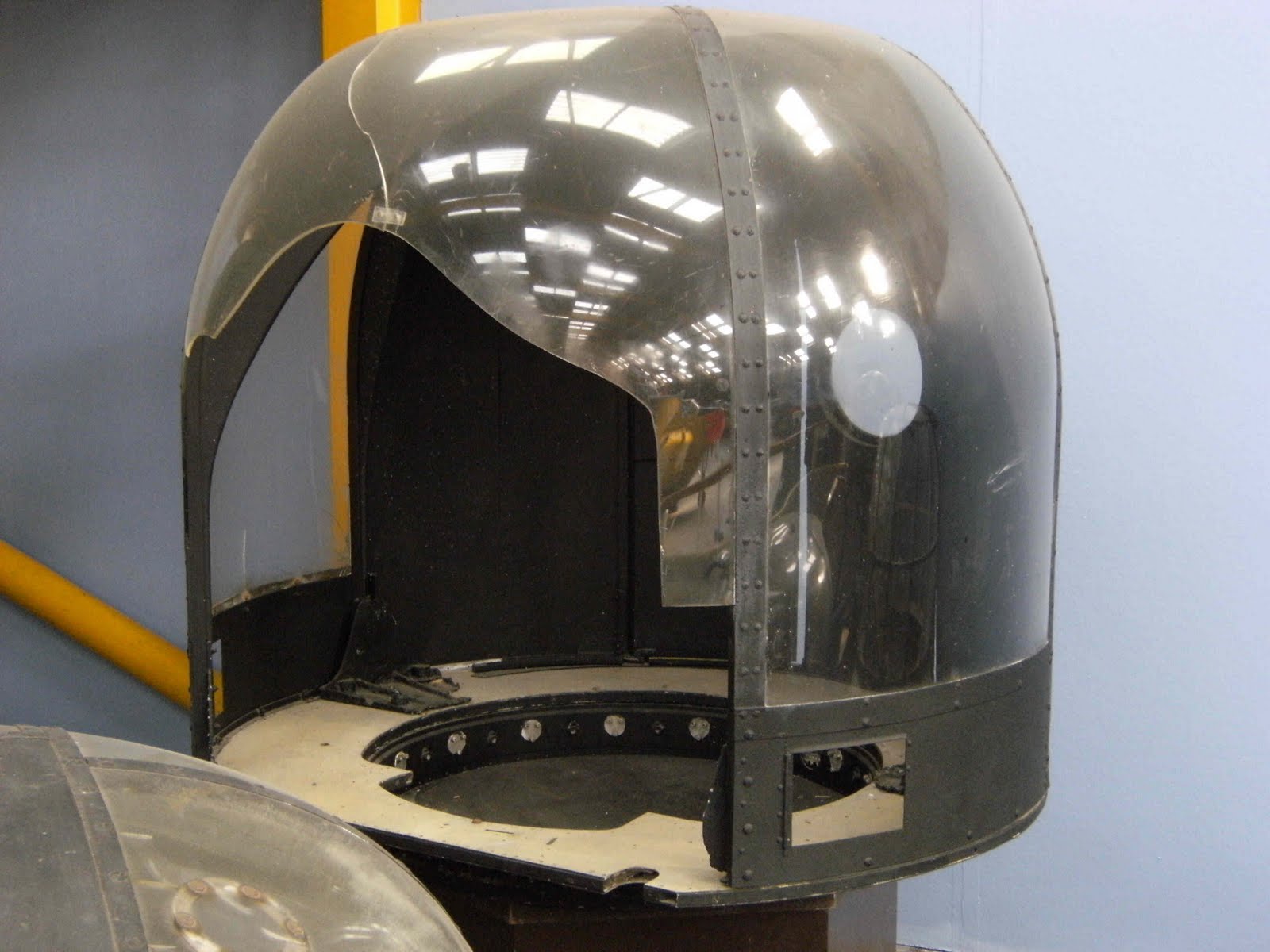
The Mid Upper Turret would have been equipped with two 0.303 inch Browning machine guns.

Hiding in the corner near the turrets is this Upkeep mine. This test bomb was recovered in June 1997, having been dropped at Reculver in 1943.

The Upkeep mine was one of three bombs designed by Barnes Wallis that were being tested for attacks against Germany. The Royal Navy had shown interest in a bouncing bomb with the idea of using this method for attacking the Tirptiz, codenamed Highball. There was also a smaller version, Baseball. This was to be a bomb that could fire at warships from motor torpedo boats. The whole family of bombs were given the codename “Golfmine”.
With time going against us, we found refuge inside the café for a well deserved cheese and ham toastie before heading back into the shop. Along the back wall was any boys dream with a plethora of model aircraft.

The item that caught my eye was this

now all I have to do is grow so that I’m the size of a six year old. Now that could take some time!
Sunday, 20 June 2010
Chocks Away Part 1
Hands (or paws) up all those who are guilty of ignoring what is on their doorstep. My paw is half raised, as are Ian and Guzzisue’s hands.
Over the years when Ian’s nephew and niece were up from Southampton we would take them to a local place of interest or an event. Recently they are content with going around the shops or the cinema.
A few years ago we had a Canal Museum in Nottingham, which we visited on several occasions. However, this was closed down due to lack of visitors. Upon hearing of the loss, a listener to our local radio station rang in to complain about this. They were asked one question by the presenter
“Have you ever been to the museum?”
Not surprisingly the answer was an emphatic “No”, and still they argued the toss about the closure.
The museum is now a canalside bar, as if we needed any more!
I have previously posted about Nottingham’s Big Night Out, an idea of BBC Radio Nottingham’s Breakfast Show presenter Andy Whittaker. Following on from this, we now have the Big Day Out. This is an event in which many of the museums within Nottinghamshire open their doors for free. This was the incentive we needed to visit one of the museums that we have passed by countless time throughout time.
Newark Aircraft Museum is partly hidden from the roadside but well signposted. It is situated between the A46 and A17, with access down a short track.
Having peered through the fence for a few minutes we ventured into the shop/museum entrance, a printout showing the Radio Nottingham Big Day Out list of places to visit was all we needed to gain entrance. We were handed a ‘Suggested walking tour’ sheet, which was promptly ignored as we headed for the largest exhibit on show, the Avro Vulcan B.2 XM594.

XM594 was first flown in 1963 and soon was deployed to the Blue Steel armed independent British Nuclear Deterrents Force with 27 squadron at RAF Scampton. It was later transferred to Waddington before once again returning to Scampton.
Refurbished in 1972, XM594 spent the next few years being transferred to different squadrons until February 7th 1983 when it was flown from RAF Waddington to Winthorpe.
Leaving XM594 behind we wandered around the perimeter stopping briefly at G-BFTZ. This aircraft is a Socata MS.880B Rallye Club. Designed by Morane Saulnier, the Rallye originated when the French Government held a competition for a light aircraft in the 1950’s. The aircraft is still in production in Poland as the “Koliber”.

Originally registered in France as G-BFTZ, it flew with the registration F-BPAX. The record books show that this aircraft was first registered in the United Kingdom in 1978 and passed through several owners before being removed from the serviceable aircraft list in 1994. It arrived at the museum in 1996.
Trying to hide in the corner of the museum’s grounds was this Handley Page, Hastings T.5 TG517.

This aircraft was designed to be a multi-purpose transport aeroplane and in later years was used for training.
TG517 was the19th to be produced and came into service in 1948, during this period the aircraft took part in “Operation Plainfare”, The Berlin Airlift.
In 1950, TG517 was fitted with special weather reconnaissance equipment and served in Northern Ireland until 1958, after which it was one of five aircraft to be fitted out with radar bomb-sight equipment before being allocated to the RAF Bombing School at RAF Lindholme, where it remained until 1968.
TG517’s last operations were from RAF Scampton, where the aircraft saw active service in the Icelandic “Cod War” flying four fishery protection sorties. She was finally flown into the museum in 1977.
For a small charge of 50 pence, several of the aircraft had their cockpits open for view. These also had an accompanied guide giving details about the aircraft. There had been a steady queue to look inside the Vulcan, so we took the opportunity to have an inspection of the Hastings.

Having climbed the steps into the fuselage and paid our entry, the guide gave us a brief history of the aircraft before letting us inspect the rest of the aircraft.
The seats shown in the above photo can be removed and be replaced with stretchers, if the need should arise. There are also hooks in the floor so that large cargo can be transported, making it a very versatile aircraft. In the background we can see part of the radar bomb-sight equipment from a Vulcan. This was used for the training of Vulcan, Phantom and Buccaneer crews. With no one looking I had the opportunity to have a go myself. Left, left, right, steady, whoops. Go round again. (With all apologies to Cockersdale)

Realising that I would never make a Biggles Ted I clambered down and went to have a look at the cockpit.

I assume the buckets are to catch either condensation from behind the console or water that may gain entry either through weakened nose panels or the cockpit . Please correct me if I’m wrong on this assumption.
Continuing around the perimeter we stopped briefly at this Mikoyan-Gurevich MIG-23M “Flogger”.

Designed between 1964-66, the MIG-23 was a successor to the MIG-21. Besides having a more powerful engine it also had a variable sweep wing with three settings, 16, 45 and 72 degrees. With the wings swept right back, the aircraft has a greater speed, while fully spread it was able to carry a heavier weapons load.
The prototype first flew in public during the aviation Day Flypast at Domodedove Airport, Moscow on 9th July 1967and entered service in 1970, becoming fully operational in 1973.
In contrast to the MIG-23, this English Electric Lightning T.5 XS417 has had a chequered career.

XS417 was the first production T.5 and flew 47 development flights before joining 226 OCU at RAF Coltishall, Norfolk in 1965. At the end of this year it transferred to 23 squadron RAF Leuchars, Fife, where in 1965 it suffered a Cat.3 ground explosion in July 1966.
Between 1974 and 1987, XS417 passed through several squadrons and had periods when it was placed into storage. On 6th April 1987, XS417 flew in the LTF’s formation flypast at RAF Binbrook. One month later the aircraft was once again placed into store, this time being stripped for spares. The museum bought the aircraft in 1988 and cut the wings off before transporting it back to Newark Air Museum in September 1988.
Around the museums grounds are an engine display hall, an exhibition hall and two display hangers that contain more aircraft. I will discuss this on my next post.
Subscribe to:
Posts (Atom)