Thursday, 22 July 2010

Chocks Away Part 2

For the concluding part of this daytrip, I am going to concentrate on two aircraft and a collection of exhibits that should have been in closer proximity to each other.This is the sight that greeted us in the hanger after we had looked at a model display of an operations room plotting the Luftwaffer’s approach over the English Channel.


In the left foreground we can just make out “the UK’s smallest piloted aircraft”, as advertised in the 1960’s. Still uncompleted, it is the design of Mr M Ward from near Newark. However it is the aircraft on the right that grabbed our attention.


This is a replica of Lee Richards Annular Biplane. Its number is BAPC No.20, or in its entirety British Aviation Preservation Council Number 20.

The aircraft is based on an original design, featuring an annular (circular) wing. It was built for the 1965 film Those Magnificent Men In Their Flying Machines, in which it was ‘flown’ by the character Harry Popperwell, played by Tony Hancock.

Newark Air Museum acquired the aircraft in 1967, shortly before it was due to be destroyed. Originally stored in Newark, it moved to the museum in the early 1970’s where it remained in storage awaiting restoration. In February 2000 it was then placed on loan with the Shoreham Airport Historical association, who then proceeded to restore it to its former glory. After a brief period with it being displayed at their West Sussex site the aircraft returned to Newark in August 2006.

The Gnat was adopted by the RAF’s aerobatic team in September 1964, making their first public appearance at the Farnborough Air Show. Originally named the ‘Yellowjacks’ as their aircraft were painted yellow, the name was changed in 1965 when a new paint scheme was adapted, with a name change to The Red Arrows.


The Gnat remained the Red Arrows chosen aircraft until the end of 1979 when it was replaced by the BAe Hawk.

The Gnat on display is painted in red and white, similar to the Red Arrows colour scheme. This design was used by training command at RAF Valley.

Designed by W.E.W. Petter, the Gnat was part of a private venture for the Folland Aircraft Company. XR534 was built at Hamble, Hampshire and entered RAF service in 1963.

XR534 had an extensive flying career before being reconditioned at Dunsford, Surrey in 1969, followed by major servicing at RAF Kemble, Gloucestershire in early 1974. Overhaul complete and the Gnat travelled to No. 4 Flight Training School at RAF Valley, Anglesey in March of the same year. It served with the School until it was replaced with Hawks in 1977.

To the left of the Gnat is a Gnat Procedures Trainer. This was used to train cadets in basic cockpit drills and escape techniques.

Propped against the hanger wall, in the proximity of the Gnat is this well made stained glass picture of a Lancaster bomber.


I can only assume that this is a memorial to Squadron 617, the Dambusters squadron. There was no information about this piece of work, thus leaving me none the wiser.

At the far end of the hanger are two Lancaster bomber turrets. The rear turret below was built by Rose Brothers Ltd of Gainsborough, Lincolnshire and housed twin 0.5 inch Browning guns with a fifing capacity of 335 rounds per gun.
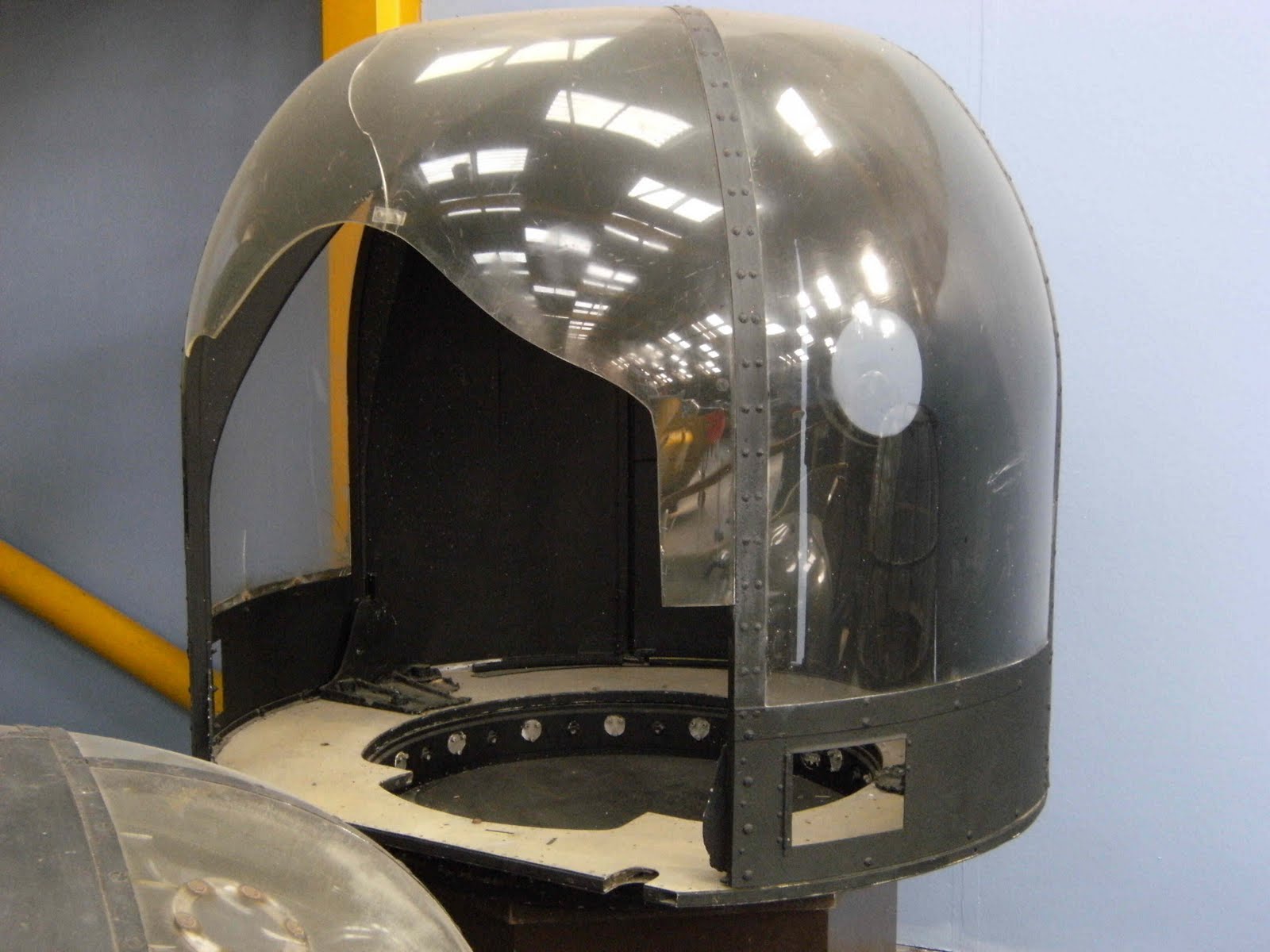


The Mid Upper Turret would have been equipped with two 0.303 inch Browning machine guns.


Hiding in the corner near the turrets is this Upkeep mine. This test bomb was recovered in June 1997, having been dropped at Reculver in 1943.


The Upkeep mine was one of three bombs designed by Barnes Wallis that were being tested for attacks against Germany. The Royal Navy had shown interest in a bouncing bomb with the idea of using this method for attacking the Tirptiz, codenamed Highball. There was also a smaller version, Baseball. This was to be a bomb that could fire at warships from motor torpedo boats. The whole family of bombs were given the codename “Golfmine”.

With time going against us, we found refuge inside the café for a well deserved cheese and ham toastie before heading back into the shop. Along the back wall was any boys dream with a plethora of model aircraft.


The item that caught my eye was this


now all I have to do is grow so that I’m the size of a six year old. Now that could take some time!

Sunday, 4 July 2010

What Is It?

Yesterday Ian and myself travelled along a road so straight and tedious, even the Romans would query as to where they were. The road in question was the A50. Fortunatly we only had to traverse half way along, to Uttoxeter Racecourse.

The VJMC were in attendance with their 4th motorcycle show at this particular venue, report to follow at a later date.

Many different clubs attended and also some weird and wonderful machines from the past. The question I'm putting to you, my reader, what does this engine power and who do you think might own it?

Meanwhile I must finish part two of Chocks Away

Sunday, 20 June 2010

Chocks Away Part 1

Hands (or paws) up all those who are guilty of ignoring what is on their doorstep. My paw is half raised, as are Ian and Guzzisue’s hands.

Over the years when Ian’s nephew and niece were up from Southampton we would take them to a local place of interest or an event. Recently they are content with going around the shops or the cinema.

A few years ago we had a Canal Museum in Nottingham, which we visited on several occasions. However, this was closed down due to lack of visitors. Upon hearing of the loss, a listener to our local radio station rang in to complain about this. They were asked one question by the presenter

“Have you ever been to the museum?”

Not surprisingly the answer was an emphatic “No”, and still they argued the toss about the closure.

The museum is now a canalside bar, as if we needed any more!

I have previously posted about Nottingham’s Big Night Out, an idea of BBC Radio Nottingham’s Breakfast Show presenter Andy Whittaker. Following on from this, we now have the Big Day Out. This is an event in which many of the museums within Nottinghamshire open their doors for free. This was the incentive we needed to visit one of the museums that we have passed by countless time throughout time.

Newark Aircraft Museum is partly hidden from the roadside but well signposted. It is situated between the A46 and A17, with access down a short track.

Having peered through the fence for a few minutes we ventured into the shop/museum entrance, a printout showing the Radio Nottingham Big Day Out list of places to visit was all we needed to gain entrance. We were handed a ‘Suggested walking tour’ sheet, which was promptly ignored as we headed for the largest exhibit on show, the Avro Vulcan B.2 XM594.


XM594 was first flown in 1963 and soon was deployed to the Blue Steel armed independent British Nuclear Deterrents Force with 27 squadron at RAF Scampton. It was later transferred to Waddington before once again returning to Scampton.

Refurbished in 1972, XM594 spent the next few years being transferred to different squadrons until February 7th 1983 when it was flown from RAF Waddington to Winthorpe.

Leaving XM594 behind we wandered around the perimeter stopping briefly at G-BFTZ. This aircraft is a Socata MS.880B Rallye Club. Designed by Morane Saulnier, the Rallye originated when the French Government held a competition for a light aircraft in the 1950’s. The aircraft is still in production in Poland as the “Koliber”.


Originally registered in France as G-BFTZ, it flew with the registration F-BPAX. The record books show that this aircraft was first registered in the United Kingdom in 1978 and passed through several owners before being removed from the serviceable aircraft list in 1994. It arrived at the museum in 1996.

Trying to hide in the corner of the museum’s grounds was this Handley Page, Hastings T.5 TG517.


This aircraft was designed to be a multi-purpose transport aeroplane and in later years was used for training.

TG517 was the19th to be produced and came into service in 1948, during this period the aircraft took part in “Operation Plainfare”, The Berlin Airlift.

In 1950, TG517 was fitted with special weather reconnaissance equipment and served in Northern Ireland until 1958, after which it was one of five aircraft to be fitted out with radar bomb-sight equipment before being allocated to the RAF Bombing School at RAF Lindholme, where it remained until 1968.

TG517’s last operations were from RAF Scampton, where the aircraft saw active service in the Icelandic “Cod War” flying four fishery protection sorties. She was finally flown into the museum in 1977.

For a small charge of 50 pence, several of the aircraft had their cockpits open for view. These also had an accompanied guide giving details about the aircraft. There had been a steady queue to look inside the Vulcan, so we took the opportunity to have an inspection of the Hastings.


Having climbed the steps into the fuselage and paid our entry, the guide gave us a brief history of the aircraft before letting us inspect the rest of the aircraft.

The seats shown in the above photo can be removed and be replaced with stretchers, if the need should arise. There are also hooks in the floor so that large cargo can be transported, making it a very versatile aircraft. In the background we can see part of the radar bomb-sight equipment from a Vulcan. This was used for the training of Vulcan, Phantom and Buccaneer crews. With no one looking I had the opportunity to have a go myself. Left, left, right, steady, whoops. Go round again. (With all apologies to Cockersdale)


Realising that I would never make a Biggles Ted I clambered down and went to have a look at the cockpit.


I assume the buckets are to catch either condensation from behind the console or water that may gain entry either through weakened nose panels or the cockpit . Please correct me if I’m wrong on this assumption.

Continuing around the perimeter we stopped briefly at this Mikoyan-Gurevich MIG-23M “Flogger”.


Designed between 1964-66, the MIG-23 was a successor to the MIG-21. Besides having a more powerful engine it also had a variable sweep wing with three settings, 16, 45 and 72 degrees. With the wings swept right back, the aircraft has a greater speed, while fully spread it was able to carry a heavier weapons load.

The prototype first flew in public during the aviation Day Flypast at Domodedove Airport, Moscow on 9th July 1967and entered service in 1970, becoming fully operational in 1973.

In contrast to the MIG-23, this English Electric Lightning T.5 XS417 has had a chequered career.


XS417 was the first production T.5 and flew 47 development flights before joining 226 OCU at RAF Coltishall, Norfolk in 1965. At the end of this year it transferred to 23 squadron RAF Leuchars, Fife, where in 1965 it suffered a Cat.3 ground explosion in July 1966.

Between 1974 and 1987, XS417 passed through several squadrons and had periods when it was placed into storage. On 6th April 1987, XS417 flew in the LTF’s formation flypast at RAF Binbrook. One month later the aircraft was once again placed into store, this time being stripped for spares. The museum bought the aircraft in 1988 and cut the wings off before transporting it back to Newark Air Museum in September 1988.

Around the museums grounds are an engine display hall, an exhibition hall and two display hangers that contain more aircraft. I will discuss this on my next post.

Saturday, 3 April 2010

Whoops

This is an event that happened to Ian many years ago and I hope will act as a reminder to anyone getting their motorcycle out of hibernation right now.

Upon returning from our first Cornish rally, Ian parked the Guzzi on the drive for half an hour to unpack and get a drink before returning it to his shed at his father's. The drive is so steep that he is thinking of building a small funicular railway to aid assent.

Refreshed he swung a leg over the Guzzi, started the engine, went a few inches....and stalled. Thinking he needed more revs, the Guzzi was restarted, more revs added, forward motion, followed by an almighty thud. This was the result.

It is a good idea to remove the disc lock before trying to set off!

When the weekend was over the follow conversation ensued:

Ian: Have you got a disc for a Calli in stock?

Storeman: Trying to set off with a disc lock on have we sir?

Ian: Yeah. How did you guess?

Storeman: We used to keep only one in stock, we now have to keep five.

Cost of this lapse in concentration? A mere £130 + VAT and postage.

For some reason, Ian now uses a long chain that threads through the rear wheel and the lock sits on the pillion seat.

All this has got me thinking as to what I can do with the above disc. Can it be used like an old horseshoe on the front door at Ted Towers? Your ideas are very much welcomed.


Monday, 15 March 2010

Nottingham Light Night 2010

For some time now, Nottingham has had a reputation for violence, especially at the weekends. Being a city with two universities and a cosmopolitan population, combined with the influx of stag and hen parties, the melting pot can occasionally bubble over.

Last year I posted on Nottingham's Light Night, details of which can be found here. Like many councils, knowing when they are onto a good thing, decided to make this year's event a two night affair. The overall objective of the Light Night is to try and get all age groups into the city centre at night.

Many of the city's restaurants had special offers on to entice people through their door, along with various guided walks around the town, ranging from an historical tour to Ezekial Bone's Guts and Gore Tour. St Mary's Church, in the Lace Market area of the city, had a choral evening. We listened to a part of this but were sat too close to the tea and biscuit area so the enjoyment was lost in someone's digestive.

But I'm getting ahead of myself here. Walking down Long Row towards the Old Market Square, the scene is set with the return of the pyramids and Nottingham Wheel. This has had a new name as the word "Eye" is reserved for the London Eye. London does not appear in Nottingham Eye, so being as I'm only a simple bear, cannot understand why certain organisations get so worked up over a little word.

Once again the Council Office was open for all to have a look around. We ventured in last year during Nottingham's Big Night Out, another event, started by BBC Radio Nottingham's breakfast show host, Andy Whittaker.

We proceeded down to the Congregational Hall, on Castle Gate, where I met this friendly dragon.

To prove that he was friendly I did my variation of a lion tamer in a circus.

Outside the hall was the starting point for the Goddess Parade and we watched people in their final minutes of preparation for a while. One of these was a young lady with her Fire And Ice puppet. Her mother, who can be seen in the foreground in the picture below, proudly told us that her daughter had made the puppet herself. Thanks to the power of email and Internet, kelliiexuk passed on the following information:

A group of people (7 ) at my school -Big Wood- Made it along with assistance from city arts. They ran a workshop first to give people a taster of what this prodject would be like. From that, a few people stepped in to take on the challange. The puppets 'skeletal' frame was built by willow, with a covering of glue and tissue paper, along with the decorations. It was lit by L.E.D pop-in lights which were added last thing. The legs were tied around my ankles and the arms were supported by polls.

I filmed kelliiexuk setting off on her parade walk before watching a student troupe doing some street entertainment before running up to Low Pavement to capture other parade entrants.

Meandering our way over to the Trip To Jerusalem we stopped off to watch some slides being projected onto the castle wall, complete with a quadraphonic soundtrack. I would like to say that this was produced for the Nottingham Light Night, however it had already been used in York. Down at The Trip the Morris dancing was in full flow and we had a quick chat with Mike from the Dolphin Morris .

Walking back up Castle Road and into Nottingham Castle grounds we were just in time to watch our council tax go up in colourful smoke.

This was done on the hour throughout the evening to the enjoyment of many.

The evening was really beginning to chill down, so, across town we traped to previously mentioned St Mary's, situated in the Lace Market area of Nottingham, after which it was back to the Market Square to catch a few tunes from local band, Wholesome Fish.


Leaving The Square behind us to head for Exchange Arcade, situated at the back of the Council House, we almost literally bumped into an old friend from last year, so we stayed and watched him make acquaintances with a group of people.

Upon entering the Arcade, the Sinfonia Chorale were in full voice with their voices dancing around due to the superb acoustics inside the small setting.

Heading up Long Row and back towards our parked car we were pleased to see the Dukesbox back in town.

As you can see, the Dukes had quite a large audience and were keeping them entertained with Zeppelin, Madonna, Elvis Costello and Vanilla Ice (remember him?) covers.

Our last stop was after we caught up with the Motoring Nun.


She? was riding round on an electric piano and stopped briefly to have a jamming session with a late night busker. I managed to capture part of this on my video below.


And so endith our Light Night, thank you Sister for the send off.

The images below show all the events that were happening over the event. Other towns and cities throughout the United Kingdom are now hosting similar events. Click here to find out if there is one near you.

Here's looking forward to 2011.

Finally, once again, I must thank Guzzisue for the use of her photographs as Ian and myself were far too busy trying to use the video and keep our hands/paws warm.

Sunday, 21 February 2010

1930's Hints And Tips Part 2

With the snow falling outside could there be anything better to do but keep a promise? So here is part 2 of Hints and Tips, 1930’s style, interspersed with advertisements from the sponsors. Where would we be without then and where are they now?

CARBURETTERS AND FUEL SYSTEM

FLOODING

58. If the flooding persists, try the effect of lowering the float a short distance, say 1/16in. down the needle; this is accomplished by filing a small nick in the needle the required distance under the existing nick and anchoring the float at this point. Finally, see that the carburettor is fitted absolutely vertical.

BRAKES

Care of Linings

38.- Washing off Grease

Attention to a few small details will often turn poor brakes into quite efficient ones. Grease on the linings, due to over-lubrication of the hubs, is a frequent cause of inefficiency. Examine the linings, therefore, and if there is plenty of wear left, wash them thoroughly with petrol, using a small stiff brush, such as a nail brush, and allow them to dry. Do not burn off the petrol by setting the linings alight; this may fuse the wire bonding.

ELECTRICAL ACCESSORIES

Voltage Control

23. Present-day motor cycles are almost invariably fitted with voltage control of the dynamo, i.e., the lighting system incorporates a device that regulates the output of the dynamo according to the state of charge of the battery. Owners of older systems can usually obtain conversion parts from the makers of their particular set.

BOWDEN CABLES

Soldering

Soldering a Nipple

34. Soldering a Bowden nipple is an easy job, but requires care if it is to be done efficiently. First, the soldering iron must be properly “tinned”, or, in other words, covered with a bright, silvery coating of solder. The bit should be heated, its point filed clean, and then, before it has time to cool, dipped in the flux and rubbed on a stick of solder.

Before a Bowden cable is severed, the wire must be bound by an impregnation of solder, or it will immediately unravel when cut unless it happens to be of the special “non-unravel” type. Apply a little flux to a section of the wire about half an inch long at the spot where it is to be cut. Then dip the hot iron into the flux, and, pressing it on to a stick of solder, pick up a blob. Run the solder into the cable vary carefully, making sure that all the interstices are filled. When the solder has set, the wire can be safely cut with a sharp pair of pliers.

If an old nipple is to be used again, all the old solder must be run out by pressing the hot iron against it and then tapping it to dislodge the molten solder. A gas flame will do the job even more easily than the iron. The nipple must, of course, be absolutely clean. Then, having dipped the end of the cable into the flux, thread the nipple on to the wire, leaving about 1/16th in. (or rather less, depending upon the type of nipple) protruding, and apply some more flux to the cup of nipple itself.

Pick up some solder with the iron, and apply it to the nipple, allowing the solder to run down inside the nipple. Then, with an old clean penknife or a clean screwdriver, turn back the separate strands of the protruding cable, and splay them out radially in the cup of the nipple. Finally, fill the cup with solder, and the job will be complete. If this method is adopted a perfectly neat job will result, and, due to the splaying out of strands, there will be no chance of the nipple pulling off.

The book is full of advice for the home mechanic with helpful tips from an era when a motorcycle was a cheap form of transport for families. How times change. When consumables become more expensive and motorcycles are seldom seen in bad weather. Cheap winter hacks seem few and far between today and appear to be more costly than buying an old car.

In the days of central heating, working from home, better public transport (?), the question and answer can be the same two words. Why bother.

Saturday, 23 January 2010

1930's Hints And Tips

Recently while having nothing better to do, I was browsing through some books on the shelf. Ian has several motorcycle related volumes and a small publication that was almost hidden attracted my attention.

Published in the late 1930’s by Iliffe & Sons Ltd of London and issued by The MotorCycle magazine was the 13th edition of Hints and Tips for MotorCyclists. Inside there are 721 hint and tips of historical interest, a few of which Ian put to the test in his budding motorcycling youth. There is also a small advertisers section at the back. To prove that using well known faces is nothing new, we see Stanley Woods claiming that motorcycles run better on Mobiliol ‘D’.


Below, I have reproduced a few to serve as a reminder as to how things were for the motorcyclists of yesteryear.


ELECTRICAL ACCESSORIES
Speedometer Lamp

21. A speedometer lamp is a useful accessory, especially if much night-riding is done in built-up areas. All new machines have their speedometers floodlit internally. In the case of an old mount, it is possible to obtain a clip-on or bolted-on speedometer lamp at a cost of two or three shillings.


CARBURETTERS AND FUEL SYSTEM

Removing Dents from a Tank

75. When a tank or similar sheet-metal container has been damaged it is usually impossible to remove the dent by pressing it back from the inside, owing to the difficulty of inserting a suitable tool. If, however, the tank is of comparatively light sheet metal the dent can sometimes be pulled back by soldering a bolt head in it and pulling on the bolt.


RIDING METHODS

Hills

134. When a steep and slippery hill has to be ascended, as in a trial, especially with a sidecar outfit, to lower the pressure in the rear tyre. If there is time before the next hill, pump it up again.


RIDING KIT

Rubber Ponchos

450. In the days of long-distance trials ponchos were the experienced competition rider’s choice. They are made of black rubber with a cloth backing and are slipped over the head. Two types of neck opening are obtainable: (1) flexible rubber, and (2) a gusseted affair with a hook and press-studs, or with a Zipp fastener. The latter is the more convenient so far as putting on and taking off the poncho is concerned, and lasts better, but the former, due to the soft rubber clinging to the neck, naturally makes a more watertight “joint”.
Protecting the Legs

461. Many riders attach the straps on waders to their trouser buttons. A better scheme, however, is either to fix them to a small strap encircling one’s waist, or to attach a tape to the straps and loop this tape over one’s shoulders. As a result the early loss of trouser buttons will be prevented if nothing else! Straps round the ankles, or even rubber bands cut from an old car-size inner tube, will facilitate walking around in the waders, but if the waders are made too tight round the ankles the circulation will, of course, be affected.

(Ted’s tip is to invest in a pair of Wadagard ™ Motor Cyclists’ Boots. See advertisement below).
Cloth Caps

467. Ordinary cloth caps, so long as they fit well and have a large, waterproof peak are good, but they seldom stay on quite so well at speed as does a good ski-cap.

(Ted’s tip is to use in conjunction with the Jefco ™ Face Screen. See advertisement below).
Scarves

485. If funds will run to it, there is nothing to beat an angora-wool scarf for softness, warmth and general comfort. However, any good wool scarf will serve, but it should be long enough to encircle the neck twice and still reach the waist. Many riders arrange their scarves so that one end runs right down the front and passes between their legs; in this way it prevents wind and cold finding their way past the openings in the coat and trousers.


TOURING AND CAMPING

Finding Accommodation

536. If when on tour you do not happen to have a list of places at which suitable accommodation is obtainable, and no arrangements have been made beforehand, plan to end your day’s run not later than, say, six o’clock. Having arrived at the village or town at which you intend spending the night, seek out a local policeman or call in to see one of the innkeepers. These worthies as a rule can suggest houses where inexpensive, good accommodation is obtainable, assuming that is what you desire. If on the other hand you want an hotel the local policeman is generally the best man from whom to seek advice.


WORKSHOP AND USE OF TOOLS

Coin Measurements

721. Although a set of rules should always find a place in the amateur mechanic’s equipment, it sometimes happens that measurements are required without the necessary items being available. In such instances it is worth knowing that the following coins represent certain definite measurements:

One penny : 1/10th of a foot in diameter.

A sixpence : ¾ in. diameter.

Half-crown : 1¼ in. diameter.

Five halfpennies or three pennies weigh one ounce.


Now where did I put those old coins?


Here are the advertisements that are useful in conjunction with tips 461 and 467 respectively.


Even today, a long distance motorcyclist may find one of these useful. I'll have to get one of these for Ian's next birthday.


If anyone would like to read some more of these just leave a comment and 2 numbers between 1 and 720, omitting the ones already previewed.

Saturday, 9 January 2010

Banbury Run 2009

Sunday 21st of June 2009 saw Ian, Guzzisue and myself heading down the Fosse Way to Gaydon for the 61st Banbury Run. Car parking was closer to the venue this year, being in a field across the road from the Heritage Motor Centre.

As with any motorcycle event a walk round the motorcycle enclosure is always necessary. This always springs up a surprise or two. This year just happened to be this SS50 Honda moped, a model often overlooked by the more glamorous Fizzie.


Closer inspection reveals an interesting modification to the engine.


Inside the museum grounds there was one change from the previous year. The pit area was on the right hand side as opposed to the left. If this was more sheltered than last year’s it was not put to the test, as there was hardly any breeze.

Every event has three different classes.

Class A: Mainly veterans prior to 1915. These have a gentle ride of approximately 30 miles.
Class B: Early vintage machines 1915-1924. Their ride is in the 50-60 mile range.
Class C: Late vintage 1925-1930. These modern machines have a run of over 60 miles.

Both classes B and C have to negotiate Sunrising Hill, on the A422. This is a popular spectator viewpoint as riders and some of the machines limp their way to the summit, some being walked up by the rider.
Here is the route map for Class C.

Walking around the pit area I noticed that this entrant was well prepared for a final drive problem, a spare being carried.

Many entrants got into the spirit of the event by dressing in period dress. Here we see No 379, Andy Batchelor with his 1930 Raleigh MO 30

and No 365, Raymond Hudson aside his 1913, 499cc Premier 2 Speed.

Settling ourselves on the outside of the first bend, followed by relocating further up the road we proceeded to take some photos and video footage. Unfortunately many of my photos from this area were not of very good quality. More practise required. Here are just a few.

James Bridge-Butler was hoping third time lucky as he failed to finish the previous outings on his 1910 Triumph.

David Cooper on his powerful 1½hp, 1902 Quadrant,

and finally, a local connection for us as Alan Booth passed by on his friend’s 1930 Sunbeam Lion. The local connection is that the Nottinghamshire Police used this motorcycle during WWII.

Last year we cast our eyes over a Henderson. Not expecting to see another, we were surprised to see this for sale (?) in the autojumble arena.

Ian got talking to someone who mentioned that a friend of his managed to buy a smoke damaged Henderson, put it straight into an auction and doubled his money by doing nothing to it! A shrewd move indeed.

We had intended to give the 2010 Run a miss, however, having read on the Banbury Run web page that entry to the Banbury Run will also include free entry to the Heritage Museum we will try our best to attend on 20th June. See you there?


Footnote (for Affer)

As Affer spotted in the film clip there is a gentleman struggling to start his 1919, 600cc George Reed Scott. By more luck than judgement, one of the few photos I managed to take in the paddock area was this one.

Friday, 25 December 2009

Tis The Season

Well I was going out to visit Ian's relations with him and Guzzisue, however when I opened the back door to find over a foot of snow on the ground.....


All I can do is to say Seasons Greetings to one and all and a prosperous new year.